Dramas Are Meant to Be Read, but Also Heard and a. Seen. B. Analyzed. C. Memorized. D. Delivered.
Defining a Successful Delivery
Delivery is "real" when the speaker is honest and talks with the audience without acting.
Learning Objectives
List the four main qualities that make a speech "real" and draw their employ
Central Takeaways
Key Points
- Ethical — Audiences wait a public speaker's life to be a reflection of his or her bulletin.
- Conversation –Audiences in North America seem to respond more favorably to public speaking that is a natural conversation.
- Interactivity–Audiences feel connected to speakers who talk with them, rather than at them.
- Eye contact–N American audiences wait the speaker to look them in the eye.
- Voice–Each audience member expects a conversational tone just also wants to hear and understand the speaker. Public speakers should always utilize a microphone to brand sure everyone can hear.
- Gestures –Audiences expect to run across gestures that experience natural, maintain interest, and help convey the message. Gestures may include movements of the hands, face, or other parts of the trunk.
Key Terms
- ethics: The report of principles relating to right and incorrect conduct.
Keeping it "real"
Successful commitment has ii components according to Quintilian 9. A good man (or woman), speaking well has to be "real", firstly you need to know and speak the truth; and secondly, you lot cannot be posing or acting when you lot speak.

Marcus Fabius Quintilianus: A statue of Quintilianus with his hand raised to speak to a crowd.
Ethics of the speaker
Being a real person is the ethical nature of public speaking. Quintilian considered the ethical nature of the speaker beginning. The speaker is obligated to be a person of good character and speak the truth.
Ideals, also known every bit moral philosophy, is a branch of philosophy that involves systematizing, defending, and recommending concepts of right and wrong beliefs. It comes from the Greek give-and-take "ethos," which ways "graphic symbol". Not only must the speaker evangelize the speech well but he/she must be a person of proficient character. From the very early days of studying rhetoric, ethics were of import. The speaker could not just say one affair and and so do something different; he/she was called upon to live by what the he/she was saying. Speaking well, likewise means speaking justly, where eloquence, wisdom and goodness combine. The Greek philosopher Socrates suggested that evil or bad actions are the issue of ignorance and that any person who knows what is truly correct volition automatically practise it. What do yous think?

Socrates: Socrates using his "socratic" method equally he teaches a student.
How does the speaker keep it real?
Let's look at two important aspects of speaking well, which may serve as a guide.
Speaking as magnified conversation
In general, audiences in North America seem to respond more favorably to public speaking which is modeled as a natural, but magnified conversation. Public speaking is a conversation with the audience. Working with this model, you will find that certain behaviors will be more successful than others.
- Interactivity–Rather than talking "at" the audition, it's better to be speaking direct "with" the audience. You should, at least mentally, conceive of the audience as responding, asking questions and approving or disapproving of what you are saying. In essence, y'all are non lost in your own train of thought while ignoring the thoughts of the audience. At that place is interactivity or a perception of give and take between the audience and yourself as the speaker.
- Eye contact–This is an important aspect of successful delivery for North American audiences. They expect you to look them in the heart. Here and in Western Europe, centre contact is interpreted the same way: conveying involvement and honesty. People who avoid eye contact when speaking are viewed in a negative low-cal, equally withholding information and lacking in general conviction. However, in the Centre Eastward, Africa, and peculiarly Asia eye contact is seen equally being disrespectful and fifty-fifty challenging of one'southward authority. People who make eye contact, only but briefly, are seen as respectful and courteous.
- Voice–yous desire to speak naturally but loud enough to exist heard by all the members of the audition. At a minimum, you demand to be intelligible to the audience so that they can comprehend the bulletin. If you lot are not able to be clearly heard by the audience, so y'all will desire to get special help to improve pronunciation, stress and accent.
- Gestures–You are not an actor who takes on or plays a role, but rather, 1 who enlarges the gestures so that everyone tin see. A gesture is a form of non-exact communication in which visible actual deportment communicate particular messages, either in place of spoken language or together with and in parallel to words. Gestures include movement of the hands, face up, or other parts of the trunk. Today, the conversational speaker, dissimilar the old school elocutionist who focused more than on technique than substance, strives for natural gestures, which develop out of what is beingness said. As a conversational speaker you lot do not want to apply planned or fixed gestures for dramatic effect. Additionally, you lot desire to avert any gestures that, out of nervousness or habit, might distract the audience from the message.
Requirements of the occasion
Conversational speaking or dialog with the audition does non mean that you are e'er informal or apply casual speech. Different speaking occasions have dissimilar degrees of formality. The audience will judge, as so you need to arrange the appropriateness of dress, posture and word choice associated with how formal or breezy the occasion may exist. Ultimately, the successful speaker is really true to cocky and receives the desired response from the audience.
Choosing Your Method of Commitment
Speakers may or may non exist able to choose a delivery method, only keeping all-time speech practices in listen leads to success in each state of affairs.
Learning Objectives
Develop your personal delivery mode, because the four methods of speech delivery
Primal Takeaways
Key Points
- There are iv mutual methods of commitment: impromptu (piffling or not grooming), memorization, reading from prepared manuscript, and extemporaneous (with outline or notes).
- Develop a speaking persona by manifesting your own honest and sincere personality without imitating the style of others when communicating with the audience.
- Have something to say. The starting time indicator that a person is speaking well is that the speaker volition have something to say. Without ideas, opinions, or data, the speech wastes the speaker's and the audience'south time.
- Speak honestly and with sincerity. Unless you thoroughly believe in the message you lot wish to convey to others, you are not likely to impress them favorably.
- Develop your own style; practise not imitate. Speaking in a natural conversational manner ways that the speaker does not imitate the speaking style of other nifty speakers but may reflect their style or approach equally it suits the speaker'due south personality.
Primal Terms
- persona: In the written report of advice, persona is a term given to depict the versions of self that all individuals possess. The public persona will differ from the persona an individual will present when he/she happens to be alone.
- manuscript: A unmarried, original copy of a volume, article, or limerick, written past hand or fifty-fifty printed.
- impromptu: Improvised; without prior grooming.
Implications for Pick of Method
Iv Methods for Different Occasions
There are four common methods of delivery–impromptu with little or no training, memorization, reading from prepared manuscript, and ad-lib with outline or notes. Often you will non take a choice in the method of the delivery; the demands of the state of affairs or the occasion may dictate the method. For example, yous may exist chosen on to respond to what someone else has just said, or to add together a few words with no fourth dimension to ready. Or, you could be chosen upon to read a proclamation or announcement.
Impromptu
On many different occasions yous may be called upon to speak with little or no find before hand. For an impromptu speech, yous may take a minute or ii to prepare in your mind before you speak. Additionally, you may be called on to read a letter, scripture, or article to a grouping without preparation.
Manuscript
You may need to use the manuscript that is provided without adding your own thoughts or comments. However, at that place are other situations where you lot will demand to fix your own manuscript— peradventure for publication in a newsletter or to make sure you include exact wording.
Memorized
You may need to memorize a cursory spoken communication, scripture, or perhaps a poem as your part in a presentation, rather than being given a manuscript to read.
Ad-lib
In many situations you will have advanced notice, y'all tin retrieve about what you desire to say to your audience and anticipate their responses as you lot develop an outline for your message. Extemporaneous is the nearly natural of all methods of prepared delivery where you can successfully achieve a more natural conversation with the audience.
Developing a Speaking Persona for Different Situations
Yous volition want to develop your ain persona for all methods of delivery. In the study of advice, persona is a term given to describe the versions of cocky that all individuals possess. You behave according to the desired impression y'all wish to create when speaking with others. A person may create or manifest dissimilar personas at different times, for different occasions. In particular, the persona you present before others when speaking volition differ from the persona your present when you happen to be alone. Hither are some important considerations for developing a natural, conversational persona for speech communication commitment.
Have Something to Say
The first indicator that a person is speaking well is that the speaker volition have something to say. Without ideas, opinions, or data, talk becomes the most wasteful product in the world. It is not only a waste material of time to the person who insists on delivering it, but a waste of fourth dimension and patience to the people who are forced to listen. Shakespeare put a human being who had goose egg to say in to The Merchant of Venice and and so had Bassanio draw him as follows:
"Gratiano speaks an space deal of cipher, more than than any man in all Venice. His reasons are as two grains of wheat hid in 2 bushels of chaff: y'all shall seek all day 'ere you find them, and when y'all have them, they are not worth the search."
In essence, you need to think clearly and prepare the content of the message carefully earlier focusing on delivery.
Speak Sincerely
A 2d indicator of a good speaker is sincerity. Nothing can exist substituted for personal sincerity. Unless you lot thoroughly believe in the message you wish to convey to others, you are non likely to impress them favorably.
Develop Your Own Style—Exercise Not Imitate
Speaking in a natural, conversational style means that the speaker does not imitate the speaking mode of other swell speakers but may reverberate their fashion or arroyo every bit it suits the speaker's personality. For example, shows British rapper Voice communication Debelle who has developed her own sincere, conversational delivery style in her 2012 album, Freedom of Speech communication. It is a fatal mistake to set out deliberately to imitate some favorite speaker, and to mold your style subsequently that person. You may find certain ways or methods in other speakers that volition fit in naturally with your style and temperament, so y'all prefer them. Ever be on your guard against anything that might impair your own individuality—even in the slightest caste.

British Rapper Oral communication Debelle: If you develop your ain delivery manner, you volition always be prepared to requite a good speech.
Recall that speaking is a perfectly normal act, which does not telephone call for foreign, artificial methods, only simply for an extension and development of the familiar human activity of conversation. The objective is to develop and magnify your own honest and sincere persona equally a speaker without imitation when communicating with the audience.
Speaking from a Manuscript
Your manuscript delivery method will vary depending on whether the manuscript is your own or someone else's.
Learning Objectives
Explain the advantages and disadvantages of delivering a speech directly from a manuscript
Key Takeaways
Key Points
- When provided with a manuscript, yous need to deliver it exactly equally written. It is the original author's ideas and not your own that you lot are presenting to the audition.
- One important course of manuscript is a proclamation. When you read the proclamation, y'all create a distinct speech deed that puts the statements into consequence.
- After the speaker reads the manuscript and understands the meaning, he or she can practise creating a conversational commitment past emphasizing important words, creating vocal phrases with the right words together, and varying the pace and emphasis.
- If you are preparing your ain manuscript for delivery, consider commencement the audience and write for them as if you were speaking directly to them.
- Yous can at present utilise low cost personal teleprompters to help you deliver sermons, deliver speeches, and create quality audios.
Key Terms
- teleprompter: A teleprompter is a brandish device that prompts the person speaking with an electronic visual text of a speech.
- manuscript: A single, original copy of a book, commodity, or composition, written by manus or fifty-fifty printed.
- Announcement: A statement which is proclaimed; a formal public proclamation.
Yous may demand to employ the manuscript provided to you without adding your own thoughts or comments. However, there are other situations where you will need to gear up your own manuscript mayhap for publication in a newsletter or to make sure you include exact wording.
When Provided with a Manuscript
You need to delivery information technology exactly as written. You lot are delivering words which were prepared by someone else; they are the original author'southward ideas and not your ain that you are presenting to the audience. The manuscript could take many different forms. It could exist a short story, a poem, or an commodity. You may also be provided with a special blazon of document, called a proclamation.

Manuscript: A medieval Latin manuscript past Aristotle with original Greek text added in the margins.
With a proclamation, the wording is exact and must be read exactly as written, equally it is a singled-out speech act that puts the statements into event. If are reading a proclamation and say, "I now declare…" when yous finish y'all take actually made it happen.
Advantages
You usually take time to set up which volition allow you to fully empathize the meaning that needs to conveyed to the audience. Once you empathize the meaning, then information technology is possible to exercise reading to create a conversational delivery past emphasizing important words, create vocal phrases with the correct words together, and vary the step and emphasis to convey the meaning of the original. Since you lot will have the certificate with yous, you lot can mark it to indicate where you want to add emphasis, intermission, and change volume or pitch.
Disadvantages
Of form, the obvious disadvantge is that you are speaking for someone else; your are delivering his or her thoughts and ideas and not your ain. Y'all practise not have buying of the ideas only you lot may exist judged since yous are delivering the manuscript.
When preparing your own manuscript
If you are preparing your ain manuscript for delivery, consider first the audience and write for them as if you were speaking directly to them. Yous are non writing a book merely a speech to be delivered. When yous deliver the spoken communication from manuscript, you are challenged to make a connection with the audience rather than merely read words.
Advantages
Preparing your own manuscript prevents yous from proverb anything you would not say in careful consideration of your topic. Information technology does assure that you say everything yous want to say and gives the impression that you are a calm, collected thinker. You accept the opportunity to work with a teleprompter to assist you speak direct to the audience, but you will yet need to practice with its speed and placement.
Disadvantages
At that place are disadvantages for the speaker preparing his or her own manuscript. It is a challenge, since the speaker will have difficulty maintaining eye contact with the audience to show warmth and sincerity. It may also exist difficult for you to really develop a conversation with the audience while reading. Y'all want to sound natural and develop your own persona which is difficult if a person is merely reading his or her words on a page. With the necessary practice, you lot can perfect and develop a voice communication and deliver it from a manuscript with careful rehearsal.
When Working with a Teleprompter
Y'all may likewise piece of work with a teleprompter to increase eye contact and presence with the audience.
Professional person Teleprompters
A teleprompter (also called a telescript or an autocue) is a display device that prompts the person speaking with an electronic visual text of a speech communication or script. Using a teleprompter is similar to the practice of using cue cards. You tin can see the words on the screen in forepart of and usually below the camera lens of a professional video camera. The words on the screen are reflected to the eyes of the presenter using a sheet of articulate glass or especially prepared axle splitter. Since you lot do not need to look downwards to consult written notes, you lot announced to be speaking spontaneously and tin can expect directly into the camera lens or the audience.
Personal Teleprompters
Fortunately, there are cheap teleprompter software applications as well as free web-based teleprompter applications, which will allow you to use a teleprompter to help you deliver sermons, deliver speeches, and create quality audios. These entry-level products piece of work on desktops, laptops, and even tablets.

Teleprompter in use: This teleprompter is in utilise for a broadcast.
Speaking from Memory
It to your reward to memorize your oral communication in some situations, and a distracting disadvantage in others.
Learning Objectives
Demonstrate how to evangelize a speech from retentivity so that you appear natural and relatable to the audience
Key Takeaways
Key Points
- Memorized commitment takes two basic forms: the total speech or manuscript is committed to memory, or standard parts of the message are memorized and woven into each speech.
- Memorizing your speech allows you to stay in touch with your audience.
- Ane of the chief problems of delivering a speech from retentiveness is that it sounds like you are reading since you are focusing your attention on remembering the words.
- When writing your speech, write as if you were speaking naturally, straight to an audience.
Key Terms
- extemporaneous: A type of speech delivery which involves training of speaker notes prior to delivery, associated with conversational style of commitment.
Uses of Memorized Delivery
Good orators of the past were expected to deliver their speeches from memory without notes or other aids. Today, you may find it to your reward to memorize your speech or presentation.
Today, memorization takes 2 basic forms:
- The total oral communication or manuscript is committed to memory.
- Standard parts of a bulletin are memorized and woven into each speech.
Advantages
If you memorize your speech you are more probable to perform better than the speaker reading from a manuscript, since yous can stay in touch on with your audience. When speaking from memory, yous do not demand to think about what is coming next or how to express an thought as you would in extemporaneous speaking; therefore, you tin give more attention to the audience. Today, we generally admire and stress extemporaneous speaking in our gild, but many of the bully speeches in history were delivered all or partially from retention.
Disadvantages
I of the master problems of delivering a speech from memory is sounding rehearsed, or similar you are reading. Information technology is possible to memorize and deliver a speech with diverseness and accent.
Tips for the Speaker
You may employ various approaches to memorize and rehearse your speech. Below are some guidelines to follow when delivering a memorized speech:
- When writing the speech communication, write as if you were speaking naturally, directly to an audition.
- Develop an outline of the main points so memorize the outline.
- If delivering the aforementioned speech to unlike audiences over fourth dimension, memorize the individual sections and so weave them together for each occasion.
- If yous forget a word or ii or a pocket-size section, just proceed speaking.

Appoint the Audience: To be successful, a speaker should connect with the audience, not just recite words.
Overall, if you have the mental attitude that you lot are communicating with an audience rather than reciting words, you are probable to succeed.
Impromptu Speeches
An impromptu spoken communication is given with little or no preparation, unremarkably most a topic that the speaker knows well.
Learning Objectives
List ways to chop-chop fix when called upon to give an impromptu speech
Key Takeaways
Key Points
- Remember that you are generally in control of the content, so you can decide what yous are going to talk most and include topics you want to talk about.
- Your delivery will naturally exist more conversational and spontaneous.
- Since you are not well-prepared, yous may overlook some pregnant information, but audience questions tin can often help fill in the gaps.
- Become familiar with common organizational patterns and then you can use them in any situation using the three function speech outline of an Introduction, Body, and Conclusion.
Key Terms
- impromptu: Improvised; without prior preparation.
Impromptu Speech
An impromptu speech is given with little or no training, however almost always with some accelerate knowledge on the topic. When chosen to speak "off the cuff" on the "spur of the moment," is is usually considering the speaker is quite knowledgeable about the subject field. For example, if called on to speak in class, a student might give a short impromptu spoken communication near a topic that was in the assigned readings. Concern meetings as well use a "bank check in" to tell everyone else about a electric current projection. In minor breezy meetings, the audition will interrupt an impromptu speech and ask questions, which helps guide the oral communication and the information that is presented. When campaigning, politicians sometimes reply to reporters or voters nearly anywhere and at any time.

Impromptu Speech: Mohamed el-Beltagy, running for the lower house of Parliament, stops to requite an impromptu speech communication.
Advantages
Call back that you lot are mostly in control of the content you are presenting, and so you tin include topics that you want to talk about. Additionally, yous can use personal examples from experience to support what yous are proverb. Since you are an authorization on the topic, y'all want to speak with confidence like you really mean it. Your commitment will naturally be more conversational and spontaneous. Since you are not prepared with pages of notes, y'all are more likely to speak straight to the audience just like if you were speaking to another person in a conversation.
Disadvantages
Since you are non well-prepared, you may accept difficulty thinking of what to say or formulating the ideas once you get up to speak. Although you are familiar with the topic, your speech may lack details and supporting information. If the audition is passive and does not enquire questions to guide you, you may overlook some significant content. Hopefully, someone in the audition volition ask questions and then you can make full in gaps. Additionally, impromptu speaking is rarely appropriate for occasions which crave more reasoned soapbox with supporting ideas or more formal events.
Tips for the Speaker (Impromptu Preparation)
What do y'all practise if you are asked to speak at the concluding infinitesimal? Information technology is best to become familiar with common arrangement patterns and then you tin can apply them in any situation and then also consider what you lot have been asked to speak about. Are y'all presenting your opinion? State your stance, the reasons why you support that opinion, and conclude. Is it something that happened? Retell the issue from beginning to stop (start, side by side, then, etc.). Is information technology a demonstration? Explain each step in the process from start to last.
- Make sure to program an introduction and a conclusion. If possible, accept a few moments to remember about what you want to say to introduce the topic and take some way of concluding.
- Make a few notes for yourself on a card, phone, or iPad. Or, text yourself a few single words to remind yourself of the important ideas.
- Consider the elementary iii part outline of an Introduction, Body, and Conclusion, and fit your ideas into that pattern.
- Do not try to remember a detailed outline for your entire spoken language; only call up the order of of import points.
- Be sure to stop when you accept made your points.
- If you do not know what to say side by side, you can summarize and paraphrase what y'all accept just said, so will probably be set to move on to the next topic.
- Remember that, in almost situations, you will know more than about the bailiwick than the audience. Usually you will non be chosen up to speak impromptu about something yous know nothing near, so you have probably spoken about the full general topic before or y'all probably have noesis to share with others.
- Talk like you mean information technology. In other words speak with conviction. Y'all are explaining your ideas or knowledge and yous are an authorization.
- Relax!
Extemporaneous Speeches
Extemporaneous, the almost natural method of delivery, involves glancing at notes while maintaining crucial center contact with the audition.
Learning Objectives
Requite examples of note-taking strategies for extemporaneous speeches
Primal Takeaways
Key Points
- There are two popular methods for organizing ideas to create a graphical representation for speaker notes–outlining and mind or concept mapping.
- An outline is a list of items with each item divided into additional sub-items. Each level in an outline has at to the lowest degree two subcategories. There are three basic types of hierarchical outlines–sentence, topic and phrase.
- Topic and phrase are the most useful for speaker notes since they permit the speaker to quickly glance at the notes while maintaining eye contact with the audience.
- Mind mapping and concept mapping are visual representation of ideas and concepts. Both mind maps and concept maps can be used to graphically show the human relationship between ideas for a speech and equally speaker notes for delivery.
- A heed map diagram starts with a single discussion as a cardinal branch node and lesser categories every bit sub-branches going off from the cardinal node. A concept maps can have multiple hubs or nodes with clusters of concepts labeled to testify the kind of relationship.
- While extemporaneous speaking may be free of the constraints of memorization and manuscript speaking, it is not careless talk; the speaker prepares notes in accelerate in order to deliver an organized spoken communication.
Key Terms
- concept map: A diagram showing the relationships among concepts, with the concepts fatigued in rectangular boxes, which are connected with labelled arrows that denote the relationships betwixt concepts, such every bit "is a," "gives ascent to," "results in," "is required by," or "contributes to."
- mind map: A diagram used to represent words, ideas, tasks or other items linked to and arranged radially around a central central give-and-take or idea.
- ad-lib: A type of speech delivery which involves preparation of speaker notes prior to delivery, associated with conversational style of delivery.
Extemporaneous Spoken communication
Extemporaneous speaking is one of the most natural methods for delivering a prepared voice communication. You can employ an extemporaneous speech to achieve a more natural tone, menstruation and way with the audience.
Kickoff, think near your topics and anticipate the audience'south reception to your oral communication. Y'all can develop speech notes based on this preparation and use them to aid you lot during the presentation.
Preparing Speech Notes
There are ii popular methods for creating a graphical representation for notes: outlining, and mind or concept mapping.
An outline is a listing of items with each item divided into boosted sub-items. Each level in an outline has at least 2 subcategories. There are three bones types of outlines:
- Judgement outline – Each complete sentence includes a heading or unmarried sentence near the subject of the outline.
- Topic outline – Each topic is listed and functions as a subtopic of the outline'south subject.
- Phrase outline – Each short phrase entry is a subtopic of the aforementioned primary entry.
Speaking notes, topic outlines, and phrase outlines take an advantage over sentence outlines. For example, you tin can easily look at your notes for reference and as a personal reminder of which topics to discuss every bit you're speaking.
Outlines usually accept two forms: alphanumeric and decimal.
An alphanumeric outline includes a capitalized number or letter of the alphabet at the commencement of each topic. Look at the sample:
- Thesis statement: E-mail and internet monitoring is an invasion of employees' rights
- The situation: Over eighty% of today'south companies monitor their employees.
- To preclude fraudulent activities, theft, and other workplace related violations.
- To more efficiently monitor employee productivity.
- What are employees' privacy rights when it comes to electronic monitoring and surveillance?
- American employees accept basically no legal protection from mean and snooping bosses.
- In that location are no federal or State laws protecting employees.
- Employees may assert privacy protection for their own personal effects.
- Most managers believe that there is no correct to privacy in the workplace.
- Workplace communications should be virtually piece of work; anything else is a misuse of company equipment and visitor time.
- Employers take a right to forestall misuse past monitoring employee communication.
- American employees accept basically no legal protection from mean and snooping bosses.
- The situation: Over eighty% of today'south companies monitor their employees.
Decimal outline
The decimal outline shows how each item at every level relates to the whole sample.
Thesis statement:
ane.0 Introduction
….i.1 Brief history of Liz Claiborne
….1.2 Corporate surroundings
two.0 Career opportunities
….2.i Operations direction
……..2.1.i Traffic
……..2.1.2 International merchandise and corporate customs
……..2.i.3 Distribution
….2.two Product evolution
The outline could be printed or handwritten as in this adept from Richard Nixon'southward Checkers speech.

Spoken communication Notes: Notes from Richard Nixon's Checkers speech.
Mind Mapping and Concept Mapping
Heed mapping and concept mapping are visual representations of ideas and concepts. A listen map is a diagram which starts with a single discussion and so branches out from the fundamental node, with lesser categories equally sub-branches of the larger branches. Concept maps are more free-form, since multiple hubs and clusters can be created. Unlike mind maps, concept maps practise not fix on a single conceptual heart.
For example, in the mind map for pupil learning, you can view the main component idea and related ideas which connect to its branch nodes. Yous tin also employ a heed map equally speaking notes.
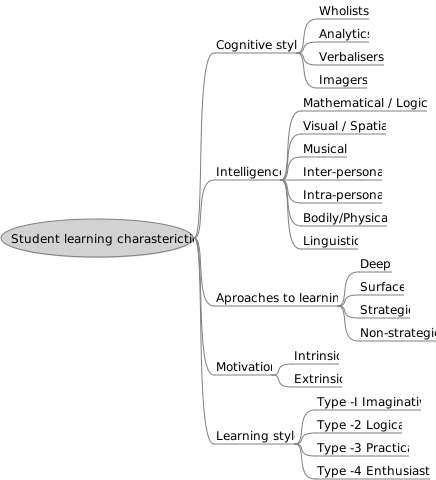
Heed Map: A mind map is a diagram that starts with ane word and expands into additional categories.
Practice and Rehearsal Guidelines
The post-obit guidelines are best practices on how to do and rehearse an extemporaneous speech:
- Speak in a conversational way by pretending yous are with your audience.
- Rehearse with your graphics and coordinate them with your talk.
- Display your graphics only when you are talking about them.
- Rehearse in forepart of others and solicit feedback.
- Tape and listen to your timed practice speech.
- Ready for interruptions and questions at the end.
Although extemporaneous speaking may not require memorization and manuscript speaking, organize and prepare your content and notes ahead of fourth dimension to deliver a speech that will be well received by your audience.

Free Speech: "Gratuitous spoken communication doesn't mean careless talk!" produced by the Function for Emergency Management.
Key Differences Betwixt Prepared and Impromptu Speeches
The key difference between a prepared and impromptu speech communication is the corporeality of time given to the speaker to rehearse and prepare.
Learning Objectives
Differentiate between prepared and impromptu speeches
Key Takeaways
Cardinal Points
- An impromptu speech is one where the speaker is given no preparation time at all.
- A prepared speech is one where the speaker is given the topic well in accelerate and the speaker is given time to research it and rehearse the speech.
- The unlike type of prepared speeches include extemporaneous, memorized, and manuscript.
Key Terms
- impromptu: Improvised; without prior grooming.
Differences Between Prepared and Impromptu Speeches
There are several different types of speeches that one tin can evangelize. They range from perfectly memorized, to completely off the cuff with no grooming at all.
Prepared Speech
The most common type of speech is a prepared speech communication. For a prepared speech, the speaker was been given the topic in advance, had time to do background enquiry on it, and has proficient delivering the speech.
This type of speech may exist used when giving a presentation or speaking in a concern coming together.

Using PowerPoint Slides: PowerPoint slides can be used in a prepared speech.
However, training does not necessarily hateful memorizing every give-and-take. A prepared speech can be an ad-lib, manuscript, or memorized speech, or a combination of these techniques. An extemporaneous speech is oft delivered with the aid of note cards to help the speaker remember cardinal points and content lodge. A memorized voice communication is one that is recited from retention without the aid of scripts or cue cards. A manuscript speech is one that has the entire spoken communication written out for reference.
When preparing for a speech i should:
- Rehearse the voice communication as it will exist presented (that is, with visual aids, standing or sitting every bit will exist appropriate for the real speech communication, etc.)
- Fourth dimension the rehearsal
- Rehearse in front of others
- If possible, rehearse in the location where the spoken language will exist delivered to become more comfortable in the space, see how the audition will view the speech, and encounter how much space is available for movement
- Create a visual and audio recording of the spoken language, and look for areas where body linguistic communication or vocal performance should be improved
Impromptu Speech
Another type of spoken communication that is less usually seen in society (but even so very useful to sympathize) is the impromptu spoken communication. Impromptu speaking occurs when the speaker is given no fourth dimension to set up for the speech communication; he or she is given a topic and must immediately begin speaking on it. This speaking mode involves thinking on one's feet and beingness able to program the catamenia of the spoken communication every bit the speaker is giving it.
While this seems like a difficult style in which to give a oral communication, virtually spoken language in a person's daily life is impromptu. People practice non background enquiry on every conversation or prepare for hours before speaking to friends. However, having to give this kind of a speech to an audience or on a topic one is not so familiar with tin can definitely be a challenge.
The most common example of a real world impromptu speech is the elevator pitch. When in an unanticipated situation where one is speaking to someone who has the ability to advance one'south career or provide an opportunity in a new field, it is crucial to exist able to deliver an excellent impromptu speech.
Additional Notes on Preparing and Delivering Impromptu Speeches
An impromptu speech is given with little or no preparation, merely the presenter is commonly very knowledgeable about the subject field matter.
Learning Objectives
Describe methods to successfully evangelize an impromptu spoken communication
Key Takeaways
Key Points
- Anticipate common questions; if you are asked about your line of work at a social event, you can have a response prepared. Having an elevator pitch ready is one fashion to ready.
- If yous call up yous will exist chosen on to speak, it is a adept idea to take a few minutes and make notes on important points.Select a familiar organizational pattern and and then add an introduction and summary determination statement to the primary ideas.
- You lot want to maintain eye contact, speak direct to the other person(due south,) and minimize racket which will interfere with your delivery at an informal event.
- In a formal, stand-upwards upshot you want to put comments in context of the occasion, maintain eye contact while glancing at notes, and utilize internal summaries and transitions to bear witness progress as you movement to the decision.
- In a Q&A session, you want to heed attentively and repeat the question that y'all are answering. If y'all do non know the reply, say so and make arrangement for a follow-upwardly electronic response.
Key Terms
- impromptu: Improvised; without prior preparation.
Additional Notes on Preparing and Delivering Impromptu Speeches
An impromptu speech communication is given with little or no grooming. Yet, you will mostly be called upwardly to speak about a topic in which yous are familiar or considered an skillful. Impromptu speeches tin take many different forms and occur in different situations. At that place are means to prepare and evangelize impromptu speeches past anticipating the more common impromptu contexts.
Preparation—Think before you Speak!
Anticipate Common Questions
In certain situations yous can anticipate the types of questions or requests which volition require a seemingly impromptu response. For instance, y'all might be asked almost your line of work at a social event. Since yous know your occupation, you can take a response prepared. Yous might have a special project or involvement that yous desire to pitch to others.
Elevator pitch
An elevator pitch is a short summary used to chop-chop identify what you exercise or what project is important to you in most 30 seconds, or the length of an elevator ride. And then, when someone asks you what you lot do for a living, you lot can speedily and seemingly without preparation requite an impromptu pitch or description.
Stand up-up Speaking Event
If yous think you will be called on to speak, it is a good idea to take a few minutes and make notes on the of import points before you speak:
- Apply a three part plan for speech. You have learned about the three part speech structure, which are Introduction, Body and Decision. Apply the structure and retrieve nearly your main points and thesis. List two or three primary ideas for the body, develop the introduction past creating an opener, and present your conclusion with a summary and a reference to the opening statement from the introduction.
- Use a common organizational blueprint. Call up about the common patterns of organization with which you are already familiar: topical, spatial, chronological, and problem/solution—choose the one that fits the ideas you have just jotted down.
- Use phrases and unmarried line notes. Make sure to brand your notes as one line phrases in outline course. Y'all can put your notes on paper or any device that allows you to chop-chop glance at a line and back up at the audience (like your smartphone).
Often, you will be presenting content that you have already covered with other audiences. On those occasions, you tin utilize the same content but yous volition need to modify the introduction to reference the electric current occasion or audience.
Delivery
Breezy Context
Many situations tin be breezy social occasions, meetings, or one-on-one talks where yous could be standing or sitting.
- Maintain middle contact—it is important in Western cultural settings to look directly at the person yous are speaking to so that y'all have each other's attention.
- Eliminate noise—yous want to brand sure that yous can actually hear each other easily in a noisy room. If you are experiencing noise, you might suggest stepping aside to a less noisy corner to delivery your short message.
Informal Meetings and Q&A
Impromptu speeches are commonly used in short informal meetings where the audience can interrupt and inquire questions to help guide the speech and retrieve the data they demand from the speaker. It is important in this situation to stay focused by repeating the question and answering it without going off on a tangent.
Stand-up Speaking Context
At that place are situations where you lot will be asked to share a few words with a large audience.You will want to apply your knowledge of public speaking to evangelize a brusk, organized speech.
- Put comments in context—y'all may desire to beginning past putting your comments in context as a manner of introducing your message. For instance, you may refer to the occasion or the previous speaker.
- Maintain eye contact—hopefully, you had a few minutes to prepare and then that you can glance at your one line notes and then support to the audience.
- Utilize summaries and transitions—brand sure to summarize and evidence connections betwixt ideas; at the finish, bring the message to closure with a summary statement.
Formal Speech communication with Q&A Session
Following a speech you will ofttimes participate in a Q & A session. Members of the audience volition ask questions and you lot will answer without fourth dimension to prepare:
- Listen attentively to the question, repeat information technology, and provide a short focused answer.
- If you do not know the answer, say so and make arrangements to respond afterwards electronically.
You are the expert; you lot will know more about the topic than your listeners. Remember that the listeners desire to hear what y'all take to say, fifty-fifty if information technology is slightly disorganized.

Q&A Sessions: Tommy Chong listens attentively during a Q&A session.
Source: https://courses.lumenlearning.com/boundless-communications/chapter/methods-of-delivery/
0 Response to "Dramas Are Meant to Be Read, but Also Heard and a. Seen. B. Analyzed. C. Memorized. D. Delivered."
Post a Comment